1 a : serving as a standard of excellence : of recognized value
I love books. I love to read. I love Goodreads - both because it helps me keep track of what I've read and because it has encouraged me to read more critically as I think ahead to reviewing a book. But I also love reading what I want to read. I clearly remember the moment I realized I could quit a book if I wasn't enjoying it.
I was lying in bed, slogging through a book when I thought to myself, "You know, no one is going to test you on this book. You're not going to have to write a paper on it." At that point, I created a personal rule: if a book doesn't have my interest by page 50, I stop reading it. I created the 50 page rule because I think some books don't jump up and grab me. I need to get to know the characters, see where the plot might take me, get a feel for the writing and the setting. But honestly? That has to happen in 50 pages or I'm not wasting my time. (This started as the 100 page rule, but 100 pages of Little Women was enough to change that.) Life is too short to read boring books.
I like the freedom to choose what I'm going to read. There's nothing better than the right book at the right time - and nothing worse than the right book at the wrong time. That (along with my busy schedule) is why I limit my book club participation - I don't want to read what someone else says to read. But without providing myself some structure, I can get into a reading rut. So I decided this year I should be a bit more targeted in some of my reading.
My first thought was that I should read one classic per month. Then I decided that was too ambitious. I settled on one per quarter instead. Then March rolled around and I realized I hadn't even started a classic, much less finished one. So I grabbed Of Human Bondage by Somerset Maugham and started it. I'd found it back in January at the used book store and thought it sounded interesting. And who doesn't want to read a book by an author with a name as cool as Somerset Maugham? That alone was enough to make me attempt it.
If a classic serves as a standard of excellence, I can see why this book is a classic. The writing? Excellent. The themes? Broad, lasting, well-addressed. The time it took to read the book? Substantial - and not just because the book was 680 pages long. The book was so packed that I could only read bits at a time before taking a mental breather. Was the book worth my time? Yes, but I'd love for my next classic to be a bit easier to read.
That's where you come in. What's your favorite classic and why? It is easy to read? A book you still think about? Does it have characters that you love?
Give me all your thoughts.
And should you be looking for your next great book, my favorite book of all time is The Book Thief. I can't say enough good things about it. If you haven't read it, read it. But first leave me a comment telling me your favorite classic!
Showing posts with label The Book Thief. Show all posts
Showing posts with label The Book Thief. Show all posts
Tuesday, April 10, 2012


Thursday, March 22, 2012
SELZNICK
: the author of The Invention of Hugo Cabret and Wonderstruck, amongst other books
Around 6 tonight, my husband came walking through the door with the mail in his hands. With a small smile on his face, he handed me a cream colored envelope addressed to A.

I didn't recognize the handwriting, so I flipped it over to see the return address.

Then I gasped. "He wrote her back!" I said to my husband. "It has actual handwriting on it. And it's postmarked from San Diego, not New York. I think he really wrote her. I can't believe it."
A was at ballet, so we had to wait two hours for her reaction. Is it bad that I wanted to open the letter right then and there? Maybe so. But I didn't open it. I waited.
As J started to leave to pick her up for ballet, I told him to be sure and take the letter. "Don't you want to get to see her open it?" he asked before leaving. Well, of course I did. I just didn't want her to have to wait one minute longer than absolutely necessary to see this. So I picked her up from ballet.
As soon as she got into the car, I turned on a light and handed her the letter. She turned it over and started to open it. "A," I said, stopping her. "Do you see who that's from?"
There was a slight pause as she looks at the handwriting. "Selznick?" she said, trying to place the name. "Oh! He wrote me back!" she said and literally started jumping up and down in her seat.
She opened the card and read his words to her, though I think ultimately they matter far less than the fact that an award winning author of books that our family loves took the time to write a note to a twelve year old girl. She will, I imagine, never forget this.

As we drove home, I told A that I've learned a lesson from this experience of hers. I explained that while I've read thousands of books in my life, I have never written a single letter to an author. "Really?" she said with amazement.
"I've always assumed they wouldn't care what I have to say," I explained to her. "When I saw that Brian Selznick wrote you back, I wondered whether I should write Markus Zusak a letter and tell him how much I love his book."
"And how much you cry every time you read it?" she asked with a smile.
One thing I have been learning this Lent is that I don't see myself very accurately. I am quick to assume that no one could possibly want to hear what I have to say. That might not be true. Markus Zusak might need to hear that his book is the best book I've ever read, that it makes me ache to write, that it captures the truth that the great pain and the great beauty of life often exist side by side. Maybe I'll get around to writing him because as she ate her dinner, a beaming twelve year old said to me, "God has great timing. I had a bad day at ballet. This letter came at just the right time."
I don't know what Brian Selznick's next book will be about. I do know we will buy it and read it. We're now lifelong fans.
Maybe you don't have a favorite book or favorite author, but who needs to hear the words you have to offer today? They could be a gift.
Around 6 tonight, my husband came walking through the door with the mail in his hands. With a small smile on his face, he handed me a cream colored envelope addressed to A.
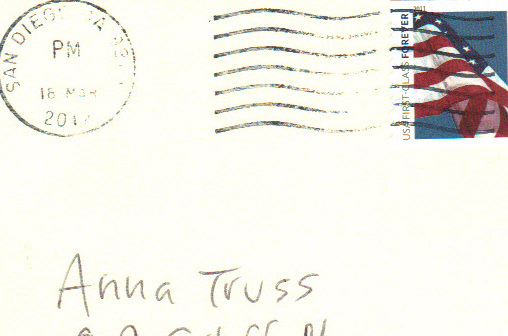
I didn't recognize the handwriting, so I flipped it over to see the return address.

Then I gasped. "He wrote her back!" I said to my husband. "It has actual handwriting on it. And it's postmarked from San Diego, not New York. I think he really wrote her. I can't believe it."
A was at ballet, so we had to wait two hours for her reaction. Is it bad that I wanted to open the letter right then and there? Maybe so. But I didn't open it. I waited.
As J started to leave to pick her up for ballet, I told him to be sure and take the letter. "Don't you want to get to see her open it?" he asked before leaving. Well, of course I did. I just didn't want her to have to wait one minute longer than absolutely necessary to see this. So I picked her up from ballet.
As soon as she got into the car, I turned on a light and handed her the letter. She turned it over and started to open it. "A," I said, stopping her. "Do you see who that's from?"
There was a slight pause as she looks at the handwriting. "Selznick?" she said, trying to place the name. "Oh! He wrote me back!" she said and literally started jumping up and down in her seat.
She opened the card and read his words to her, though I think ultimately they matter far less than the fact that an award winning author of books that our family loves took the time to write a note to a twelve year old girl. She will, I imagine, never forget this.

As we drove home, I told A that I've learned a lesson from this experience of hers. I explained that while I've read thousands of books in my life, I have never written a single letter to an author. "Really?" she said with amazement.
"I've always assumed they wouldn't care what I have to say," I explained to her. "When I saw that Brian Selznick wrote you back, I wondered whether I should write Markus Zusak a letter and tell him how much I love his book."
"And how much you cry every time you read it?" she asked with a smile.
One thing I have been learning this Lent is that I don't see myself very accurately. I am quick to assume that no one could possibly want to hear what I have to say. That might not be true. Markus Zusak might need to hear that his book is the best book I've ever read, that it makes me ache to write, that it captures the truth that the great pain and the great beauty of life often exist side by side. Maybe I'll get around to writing him because as she ate her dinner, a beaming twelve year old said to me, "God has great timing. I had a bad day at ballet. This letter came at just the right time."
I don't know what Brian Selznick's next book will be about. I do know we will buy it and read it. We're now lifelong fans.
Maybe you don't have a favorite book or favorite author, but who needs to hear the words you have to offer today? They could be a gift.
Friday, August 27, 2010
RULE
1 a: a prescribed guide for conduct or action
b: the laws or regulations prescribed by the founder of a religious order for observance by its members
c: an accepted procedure, custom, or habit
Are you a rule-follower? Or do you look for little ways to break life's rules? I recently read a very good book . It was beautifully written, flawlessly executed and had a gripping plot. But I found myself comparing it to my favorite book
 : a book with less flowing descriptions, fewer classic lines, a style all its own. One of the many things I love about The Book Thief is that the author breaks the rules. He plays with narrative technique, bends the rules of grammar, plays with readers' expectations about how a story should progress and is an expert at making abstract concepts concrete. I love the story of the book thief, but even more, I love the way her story is told. I remember reading it the first time and feeling such freedom. This book taught me to tell the story the way it needed to be told - regardless of the rules.


You see, I think I'm a rule breaker at heart. I'm not your classic rebel, but the older (wiser?) I've become, the more I've resisted blindly following the rules. I have a deep desire to carve my own path, even if it means hacking my way through the weeds, seeing the occasional snake or stepping in a hidden puddle. A character on a television show I enjoy recently said that the reason countries who were formerly part of the British empire excel is because the British imposed order. Are rules really the foundation for success? Or are they stumbling blocks to creativity, a multi-faceted society and freedom? I really don't know.
I'm certainly not an anarchist. I pay taxes (well, my husband does since I make no money!), I drive under the speed limit, we have order in our home. But I think it's worth pondering the role that rules play in my life versus the role that rules should play in my life. I would never suggest that we should each do what is right in our own eyes - that is a recipe for disaster. But where do we impose or follow rules simply because they make our lives easier, not because they are right?
I've sometimes caught myself telling my children to stop doing something not because it was wrong (hurtful, unkind, unsafe), but because it was inconvenient to me (loud, annoying, would make me late). I'm not sure that's right. In fact, I'm pretty sure it's wrong. I don't mean I shouldn't ever ask K to talk more quietly, I shouldn't ever ask A to clean her room, I shouldn't ever ask B to take her shoes and socks to her room. None of these infractions break the rules of our home, but I do think it's OK to encourage personal responsibility and appropriate boundaries. Where I think the path veers into a territory I dislike is when these common courtesies overshadow other aspects of my relationship with my daughters. I don't want to be the enforcer. I want to be their mother. And while I think it's perfectly acceptable for me to express my needs and desires to them (being a doormat of a mom does not teach them a lesson I want them to learn), I want to be careful not to hand out consequences based on actions that are inconvenient, but not wrong.
As I've pondered this, I've reflected on the difference between guidelines, rules and laws. In my mind, guidelines are strong suggestions, rules are man-made and laws are God-given. The definitions, by the way, do not fully affirm these distinctions. Rule and law are very similar words by definition. I like guidelines best because they allow some interpretation by the participants while still providing clear information about expectations. Perhaps I classify rules as man-made because that gives me the freedom to bend or break rules as I see fit. But I wouldn't argue that it's ever OK for me to bend God's laws. I just think there are an awful lot of rules our there that go far beyond those laid out in the ten commandments and well beyond the two laws Jesus says are most important. Love God? I'm trying to do that well. Love others? Yes, with God's help. But no running in the hallways? I'm pretty sure there are enough natural consequences to take care of that one.
I guess my stance on rules comes down to this: I want to be moving towards mystery, not rigidity. I think this is consistent with Jesus' reply on what matters: love is one great big mystery. And I long for my children to do the same. I hope they will embrace the things in life we will never understand. I want them to trust their inner voice even when it contradicts a rule set by someone in power somewhere. I think they were each made without a mold and I hope they will refuse to conform to rules that will alter the shape of who they are, even if that rocks the boat sometimes.
b: the laws or regulations prescribed by the founder of a religious order for observance by its members
c: an accepted procedure, custom, or habit
Are you a rule-follower? Or do you look for little ways to break life's rules? I recently read a very good book
. It was beautifully written, flawlessly executed and had a gripping plot. But I found myself comparing it to my favorite book: a book with less flowing descriptions, fewer classic lines, a style all its own. One of the many things I love about The Book Thief is that the author breaks the rules. He plays with narrative technique, bends the rules of grammar, plays with readers' expectations about how a story should progress and is an expert at making abstract concepts concrete. I love the story of the book thief, but even more, I love the way her story is told. I remember reading it the first time and feeling such freedom. This book taught me to tell the story the way it needed to be told - regardless of the rules.You see, I think I'm a rule breaker at heart. I'm not your classic rebel, but the older (wiser?) I've become, the more I've resisted blindly following the rules. I have a deep desire to carve my own path, even if it means hacking my way through the weeds, seeing the occasional snake or stepping in a hidden puddle. A character on a television show I enjoy recently said that the reason countries who were formerly part of the British empire excel is because the British imposed order. Are rules really the foundation for success? Or are they stumbling blocks to creativity, a multi-faceted society and freedom? I really don't know.
I'm certainly not an anarchist. I pay taxes (well, my husband does since I make no money!), I drive under the speed limit, we have order in our home. But I think it's worth pondering the role that rules play in my life versus the role that rules should play in my life. I would never suggest that we should each do what is right in our own eyes - that is a recipe for disaster. But where do we impose or follow rules simply because they make our lives easier, not because they are right?
I've sometimes caught myself telling my children to stop doing something not because it was wrong (hurtful, unkind, unsafe), but because it was inconvenient to me (loud, annoying, would make me late). I'm not sure that's right. In fact, I'm pretty sure it's wrong. I don't mean I shouldn't ever ask K to talk more quietly, I shouldn't ever ask A to clean her room, I shouldn't ever ask B to take her shoes and socks to her room. None of these infractions break the rules of our home, but I do think it's OK to encourage personal responsibility and appropriate boundaries. Where I think the path veers into a territory I dislike is when these common courtesies overshadow other aspects of my relationship with my daughters. I don't want to be the enforcer. I want to be their mother. And while I think it's perfectly acceptable for me to express my needs and desires to them (being a doormat of a mom does not teach them a lesson I want them to learn), I want to be careful not to hand out consequences based on actions that are inconvenient, but not wrong.
As I've pondered this, I've reflected on the difference between guidelines, rules and laws. In my mind, guidelines are strong suggestions, rules are man-made and laws are God-given. The definitions, by the way, do not fully affirm these distinctions. Rule and law are very similar words by definition. I like guidelines best because they allow some interpretation by the participants while still providing clear information about expectations. Perhaps I classify rules as man-made because that gives me the freedom to bend or break rules as I see fit. But I wouldn't argue that it's ever OK for me to bend God's laws. I just think there are an awful lot of rules our there that go far beyond those laid out in the ten commandments and well beyond the two laws Jesus says are most important. Love God? I'm trying to do that well. Love others? Yes, with God's help. But no running in the hallways? I'm pretty sure there are enough natural consequences to take care of that one.
 |
| Finding their own path |
I guess my stance on rules comes down to this: I want to be moving towards mystery, not rigidity. I think this is consistent with Jesus' reply on what matters: love is one great big mystery. And I long for my children to do the same. I hope they will embrace the things in life we will never understand. I want them to trust their inner voice even when it contradicts a rule set by someone in power somewhere. I think they were each made without a mold and I hope they will refuse to conform to rules that will alter the shape of who they are, even if that rocks the boat sometimes.
Sunday, July 11, 2010
ROSA
:rose
If you missed my earlier post, I’ll briefly fill you in: read The Book Thief. It’s the best book I’ve ever read and one reason is the characters that fill its pages:
I recently wrote about Rudy, a boy I’ve never met but love deeply. Today I’ll introduce you to Rosa, who is not all that she seems and yet is more than she seems.
Rosa could easily have been a caricature. In the hands of a writer less skilled than Markus Zusak, Rosa would be two-dimensional, sketched in to fill the space or trite. Instead, she’s a reminder to not judge someone by a tough façade. Rosa spends a good portion of The Book Thief swearing. Luckily, her swearing is done in German, so it wasn’t too off putting for me as the reader. But it still comes through loud and clear that she’s not a warm and fuzzy kind of foster mom. She’s not the stereotypical foster parent who just loves kids and misses having a young one around the house. Instead, she’s closer to the stereotype of the foster parent who takes in foster children for the paycheck. But as I said, Rosa’s not what she seems. We actually don’t ever find out exactly why Rosa and Hans take Liesel in, but we do come to know a bit of the real Rosa who hides behind the mask of the tough lady.
Rosa washes laundry for several other families and is married to Hans, a painter and accordion player. Her two children are grown and we see little of them over the course of the book. But we see a fair amount of Rosa. We see her trudge up and down the street to collect and deliver laundry. We see her lose one customer, then another, as the realities of the war set in. We see her stretch one pot of soup to feed three mouths, then four for an entire week. And we begin to see that Rosa is playing a role – not just for the reader, but for herself.
My favorite image of Rosa (who I imagine being roughly as wide as she is tall) is of her sitting on her bed in the middle of the night, holding an accordion on her lap. The room is dark and the accordion far too big to fit easily on her lap. But she holds it there and breathes with it and into it. She breathes into that accordion all of the tenderness that she pushes deep inside in order to keep the mask in place. She breathes into that accordion her dreams, her fears, her hopes. And while this is the mental picture of Rosa that I hold tight in my mind, when daylight breaks, she would not hold the accordion any longer, but a wooden spoon. Because that’s what women do – whether we’re named Rosa or Shannon – we breathe out our heart’s desires in the middle of the night and set them aside when daylight breaks. After all, there is work to be done.
If you missed my earlier post, I’ll briefly fill you in: read The Book Thief
. It’s the best book I’ve ever read and one reason is the characters that fill its pages:Liesel, the Book Thief
Rudy, the Book Thief’s best friend
Hans, Liesel’s foster father
Rosa, Liesel’s foster mother
Max, author of The Stand Over Man and The Word Shaker; Liesel’s friend
Hitler, creator of the hellish world that provides the backdrop for The Book Thief
Death, guy normally portrayed with the black robe and sickle, narrator of The Book Thief and a much more likable narrator than you could ever anticipate
I recently wrote about Rudy, a boy I’ve never met but love deeply. Today I’ll introduce you to Rosa, who is not all that she seems and yet is more than she seems.
Rosa could easily have been a caricature. In the hands of a writer less skilled than Markus Zusak, Rosa would be two-dimensional, sketched in to fill the space or trite. Instead, she’s a reminder to not judge someone by a tough façade. Rosa spends a good portion of The Book Thief swearing. Luckily, her swearing is done in German, so it wasn’t too off putting for me as the reader. But it still comes through loud and clear that she’s not a warm and fuzzy kind of foster mom. She’s not the stereotypical foster parent who just loves kids and misses having a young one around the house. Instead, she’s closer to the stereotype of the foster parent who takes in foster children for the paycheck. But as I said, Rosa’s not what she seems. We actually don’t ever find out exactly why Rosa and Hans take Liesel in, but we do come to know a bit of the real Rosa who hides behind the mask of the tough lady.
Rosa washes laundry for several other families and is married to Hans, a painter and accordion player. Her two children are grown and we see little of them over the course of the book. But we see a fair amount of Rosa. We see her trudge up and down the street to collect and deliver laundry. We see her lose one customer, then another, as the realities of the war set in. We see her stretch one pot of soup to feed three mouths, then four for an entire week. And we begin to see that Rosa is playing a role – not just for the reader, but for herself.
My favorite image of Rosa (who I imagine being roughly as wide as she is tall) is of her sitting on her bed in the middle of the night, holding an accordion on her lap. The room is dark and the accordion far too big to fit easily on her lap. But she holds it there and breathes with it and into it. She breathes into that accordion all of the tenderness that she pushes deep inside in order to keep the mask in place. She breathes into that accordion her dreams, her fears, her hopes. And while this is the mental picture of Rosa that I hold tight in my mind, when daylight breaks, she would not hold the accordion any longer, but a wooden spoon. Because that’s what women do – whether we’re named Rosa or Shannon – we breathe out our heart’s desires in the middle of the night and set them aside when daylight breaks. After all, there is work to be done.
Monday, July 5, 2010
RUDY
derivative of Rudolph: a famous wolf
I’ve read a lot of books in my life. A few because I was required to read them, many more because I wanted to. It’s hard to choose a favorite book of all time, in part because I continue to read. How can I say this or that book is my favorite when I’m constantly adding new data to the pool? But if I am honest with myself, I do have a favorite book. I came to realize that I could admit this book was my favorite after mentioning it to two people recently and having them say, "I didn't just like it. It's the best book I've ever read."
I'm not jumping on a best book bandwagon here. I can tell it’s my favorite because I’ve read it three times (the only book I have ever read that many times), have suggested it to countless people and my eyes tear up just thinking about it. If you haven’t read The Book Thief, I think you should.
There are many, many things I love about this book, but foremost are the characters that populate its pages. They live and breathe on the page and in my mind. So in an effort to pay homage to the beauty that is The Book Thief, I’d like to use this post (and possibly a few subsequent ones) to introduce you to these characters.
The second time I read The Book Thief, I told my husband, “It’s a good thing Rudy Steiner is fictional because if he wasn’t, I might have to marry him.” Rudy is easy to fall in love with. He’s a German teenager who wants nothing so much as to be Jesse Owens. He’s a foul mouthed boy who stands up for his friends when it costs him everything. He has a kind heart and hair the color of lemons.
Here is what I love about Rudy most of all: he falls in love with Liesel, the titular Book Thief, the moment he meets her. But he is content to be her friend. Even at the young age of twelve, Liesel’s had a rough life. She’s ended up on Himmel Street with her foster parents Max and Rosa after a tortuous train ride that left her more alone than a person has a right to be. So when Rudy falls in love with Liesel, she can’t love him back. She’s far too broken for that. Love requires vulnerability and Liesel is fresh out of that.
Rudy, wise beyond his years or just the kind of boy so good at heart that we only find them in novels, knows this about Liesel. So he plays soccer with her. He covers for her at school, even if it means taking a lashing from a nun. He walks with her, talks with her, lives life with her. He accepts what she can offer him, even if it’s not what he wants most: her heart. That will, of course, come to him in due time.
As I write this, I am sitting on the bathroom floor of a hotel room – victim of insomnia and an unhealthy love of books in general and The Book Thief in particular. There are tears streaking down my face as I think about Rudy. If that’s not enough to convince you to read The Book Thief, check back in a few days and I’ll introduce you to another character who might be more to your liking. There are plenty of good ones to choose from.
I’ve read a lot of books in my life. A few because I was required to read them, many more because I wanted to. It’s hard to choose a favorite book of all time, in part because I continue to read. How can I say this or that book is my favorite when I’m constantly adding new data to the pool? But if I am honest with myself, I do have a favorite book. I came to realize that I could admit this book was my favorite after mentioning it to two people recently and having them say, "I didn't just like it. It's the best book I've ever read."
I'm not jumping on a best book bandwagon here. I can tell it’s my favorite because I’ve read it three times (the only book I have ever read that many times), have suggested it to countless people and my eyes tear up just thinking about it. If you haven’t read The Book Thief
, I think you should.There are many, many things I love about this book, but foremost are the characters that populate its pages. They live and breathe on the page and in my mind. So in an effort to pay homage to the beauty that is The Book Thief, I’d like to use this post (and possibly a few subsequent ones) to introduce you to these characters.
The second time I read The Book Thief, I told my husband, “It’s a good thing Rudy Steiner is fictional because if he wasn’t, I might have to marry him.” Rudy is easy to fall in love with. He’s a German teenager who wants nothing so much as to be Jesse Owens. He’s a foul mouthed boy who stands up for his friends when it costs him everything. He has a kind heart and hair the color of lemons.
Here is what I love about Rudy most of all: he falls in love with Liesel, the titular Book Thief, the moment he meets her. But he is content to be her friend. Even at the young age of twelve, Liesel’s had a rough life. She’s ended up on Himmel Street with her foster parents Max and Rosa after a tortuous train ride that left her more alone than a person has a right to be. So when Rudy falls in love with Liesel, she can’t love him back. She’s far too broken for that. Love requires vulnerability and Liesel is fresh out of that.
Rudy, wise beyond his years or just the kind of boy so good at heart that we only find them in novels, knows this about Liesel. So he plays soccer with her. He covers for her at school, even if it means taking a lashing from a nun. He walks with her, talks with her, lives life with her. He accepts what she can offer him, even if it’s not what he wants most: her heart. That will, of course, come to him in due time.
As I write this, I am sitting on the bathroom floor of a hotel room – victim of insomnia and an unhealthy love of books in general and The Book Thief in particular. There are tears streaking down my face as I think about Rudy. If that’s not enough to convince you to read The Book Thief
, check back in a few days and I’ll introduce you to another character who might be more to your liking. There are plenty of good ones to choose from.
Subscribe to:
Posts (Atom)